For a long time, the internet operated on a simple and apparently unshakeable faith: if a thing could attract attention, then attention itself would eventually justify the thing.
This faith gave us clickbait. It gave us reaction videos, unboxing empires, prank channels, “life hacks” involving melted cheese and power drills, a generation of thumbnail faces all reacting as if the viewer had just announced the moon was armed.
It also gave us the current plague of AI slop, in which content is no longer merely cheap, sensational and repetitive, but infinitely reproducible.
Now even the platforms seem dimly embarrassed.
Before the confetti comes out, a correction: YouTube has not banned AI-generated video. It did not announce that an AI voice, image, script or editing tool automatically disqualifies a creator from making money. In July 2025, YouTube clarified a long-standing monetization rule by renaming “repetitious content” as “inauthentic content” and explicitly stating that repetitive or mass-produced material is ineligible for monetization.
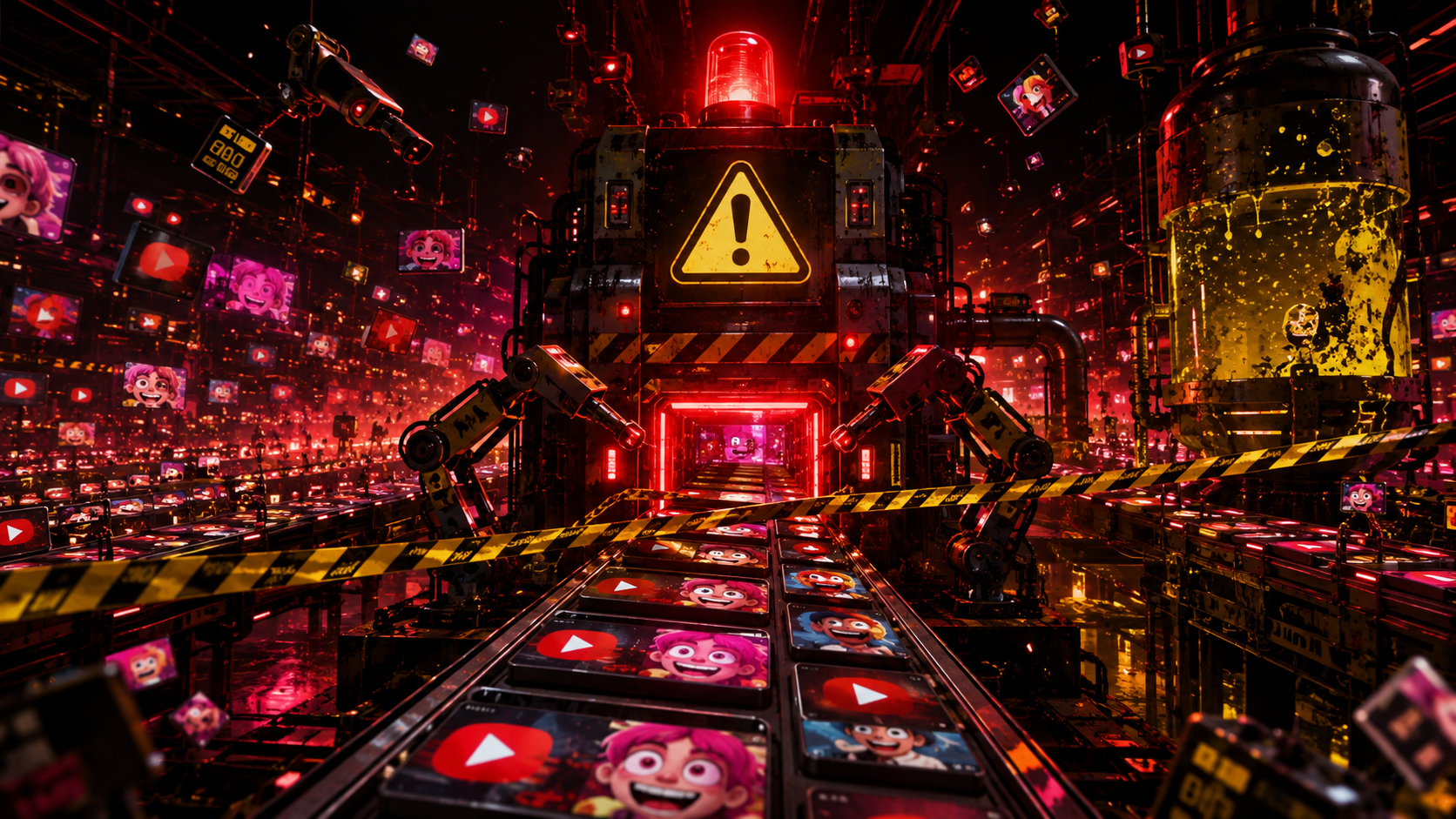
That distinction matters. AI is not the offense. The factory is.
There is a point where the factory smell becomes hard to hide
Children’s media has become one of the most revealing sites of the crisis because children are both highly valuable and easily reached.
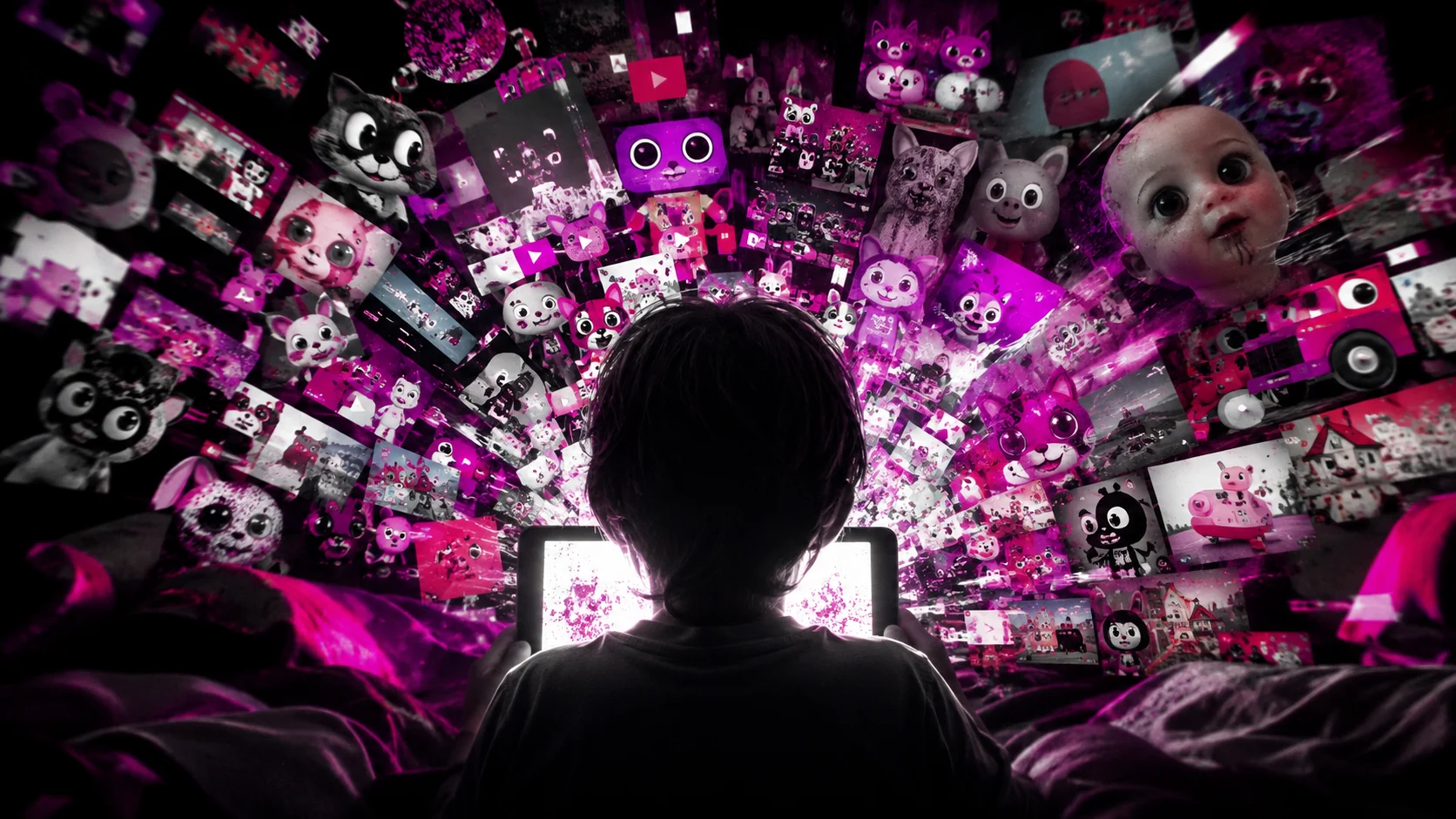
If you can generate endless videos with synthetic voices, half-formed characters, cheap music, bright colors, and attention hooks every few seconds, you do not need to make good children’s entertainment. You simply need to make enough of it, in enough shapes, with enough repetition, to catch the autoplay current.
And once the system starts rewarding the pattern, imitation becomes exponential.
One pink animal becomes twenty. One transformation template becomes two hundred. One fake educational video becomes a genre. One channel becomes a network of channels.
Because so much of it is algorithmically adjacent to legitimate children’s content, the distinction between a lovingly made show and a machine-assisted sludge chute can collapse at exactly the point where the audience is least equipped to notice.
The platforms did not invent the impulse, but they fertilized it.
You cannot build a casino and resent the slot machines
For years, the governing assumption of major content platforms has been that scale will somehow resolve quality. If there is enough stuff, then the good stuff will rise, the bad stuff will be filtered, and the user will emerge adequately entertained.
Scale does not wash away bad incentives.
It magnifies them.
Once automation entered the picture in earnest, the weak points became impossible to miss. Systems that once elevated energetic mediocrity are now capable of elevating fully synthetic nothing.
You cannot build a casino and then act surprised when someone invents a better slot machine.
YouTube’s 2025 policy clarification was modest, almost aggressively so. The company itself called it a minor update. Mass-produced and repetitive content had already been ineligible for monetization. What changed was the language used to describe what “inauthentic” looks like now.
That is still revealing. Platform policy has finally had to catch up with a production environment in which repetition no longer requires a room full of badly paid humans. A single person can run the room.
The children’s problem is larger than monetization
By 2026, the argument had moved beyond whether low-effort channels should receive ad revenue. Fairplay organized a letter signed by more than 230 organizations and experts asking Google and YouTube to take stronger action specifically around AI-generated content aimed at children.
The coalition asked for clear labels, restrictions on AI video in YouTube Kids, limits on algorithmic recommendations to minors, and stronger parental controls.
Those demands point to the uncomfortable part: demonetizing obvious sludge does not automatically redesign the recommendation system that made sludge attractive in the first place.
Removing the reward from a few channels is not the same as reconsidering an architecture built to reward stickiness.
A healthy media environment for children would not simply contain less slop. It would be structured differently from the ground up. It would privilege trust, intentionality, slower curation, real authorship, and transparent sourcing. It would make room for educators, artists, animators, and weird little humans with actual ideas.
It would not assume that systems designed to maximize adult doomscrolling are appropriate scaffolding for the imaginative lives of children.
The warning label is an admission
So yes, it matters when YouTube changes the rules around mass-produced content. It matters when the company says reducing low-quality AI material is a priority. It matters when advocacy groups can force the problem into the open.
Not because the factory is closed.
It plainly is not.
But a warning label, however timid, breaks the spell a little. It says that infinite production is not automatically creativity. That engagement is not automatically value. That a platform cannot endlessly praise the creator economy while pretending not to notice when the economy discovers it can manufacture creators out of templates.
The real scandal is not that AI slop exists.
Of course it exists. We built the perfect conditions for it.
The scandal is how long we allowed the nursery door to stand open while the factory trucks kept arriving.
Children deserve a culture, not a feed.
They deserve stories, not throughput.
They deserve delight, not optimization.
And if a platform is finally beginning to notice that, good.
Now let’s see if it notices hard enough to mean it.