There used to be a fairly simple process for making children’s entertainment.
Someone had to think of a character. Someone had to draw it. Someone had to write a song annoying enough to survive contact with a five-year-old. A set had to be built, or at least faked with conviction. Adults had to stand in a room and decide that this rabbit, or train, or strangely proportioned family of pigs, would become part of the psychic furniture of childhood.
Now a large portion of that work can be replaced by a machine that has never met a child and does not know what one is.
This is not the part where I tell you that all AI-generated content is evil. It isn’t. Tools are tools. MIT Technology Review’s Caiwei Chen made a persuasive case that some people are using generative video precisely because its weirdness can become a new visual language rather than a shortcut around having an idea. There are AI experiments with authorship, taste and actual intention behind them.
Slop is what happens when the intention disappears and the throughput remains.
Children are the perfect customers for fluorescent cereal
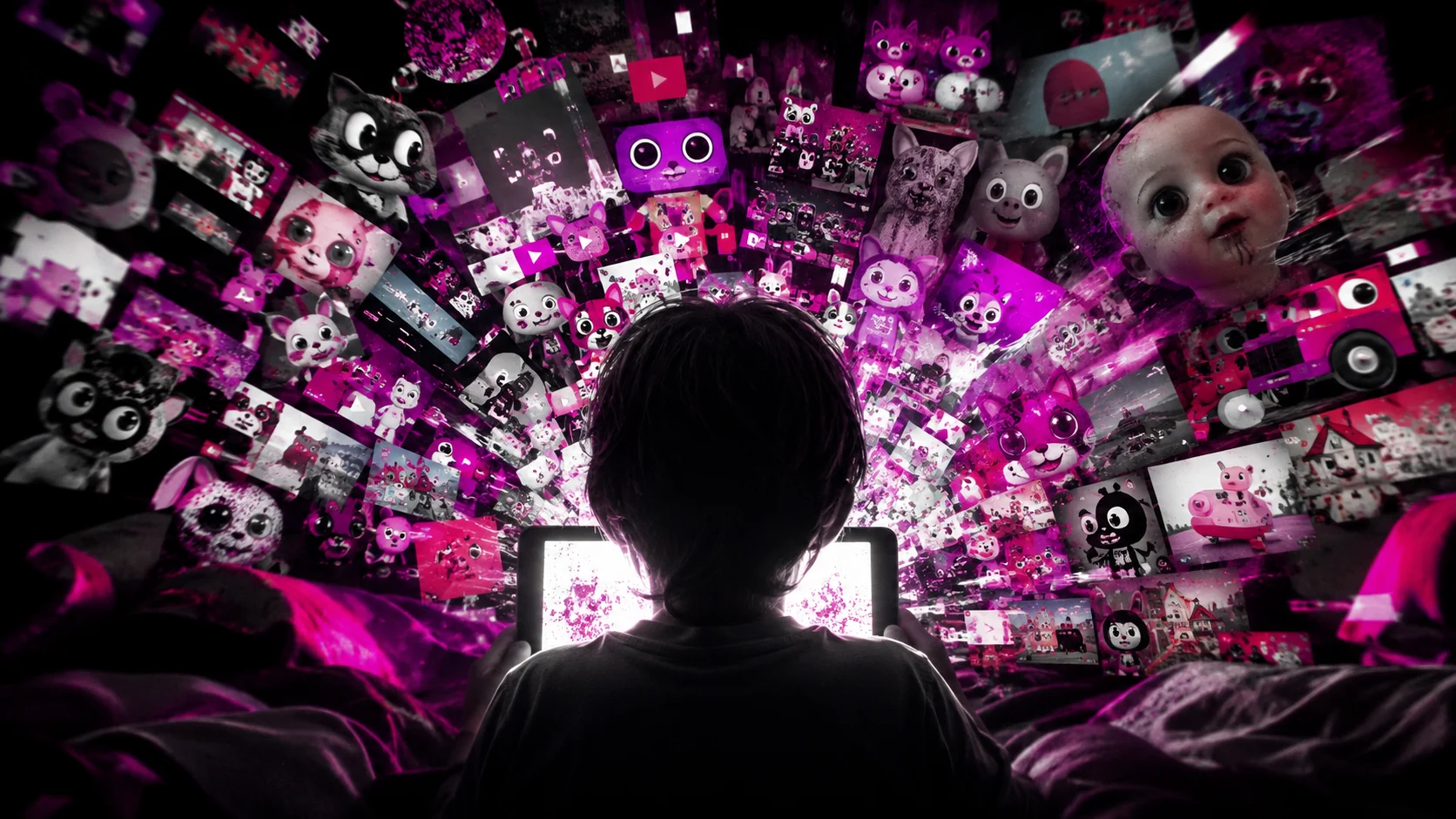
If you spend any amount of time near a tablet in a house with kids, you have probably seen the stuff. The uncanny videos with bright, overripe colors. The cartoon animals with overlarge eyes and a suspicious emptiness behind them. The nursery-rhyme remixes that sound as if they were recorded inside a haunted blender. The endless loops of pseudo-stories in which nothing truly happens except transformation, surprise, repetition, and the occasional scream in the form of a sound effect.
It is not that all of it is technically “bad” in the way a broken chair is bad. Much of it is worse than that.
It is functional.
It catches the eye. It holds the gaze. It survives autoplay. It gives the algorithm enough of what it wants to continue shoveling more of the same into the feed.
This is what makes slop different from ordinary junk.
Junk still has fingerprints. Slop has throughput.
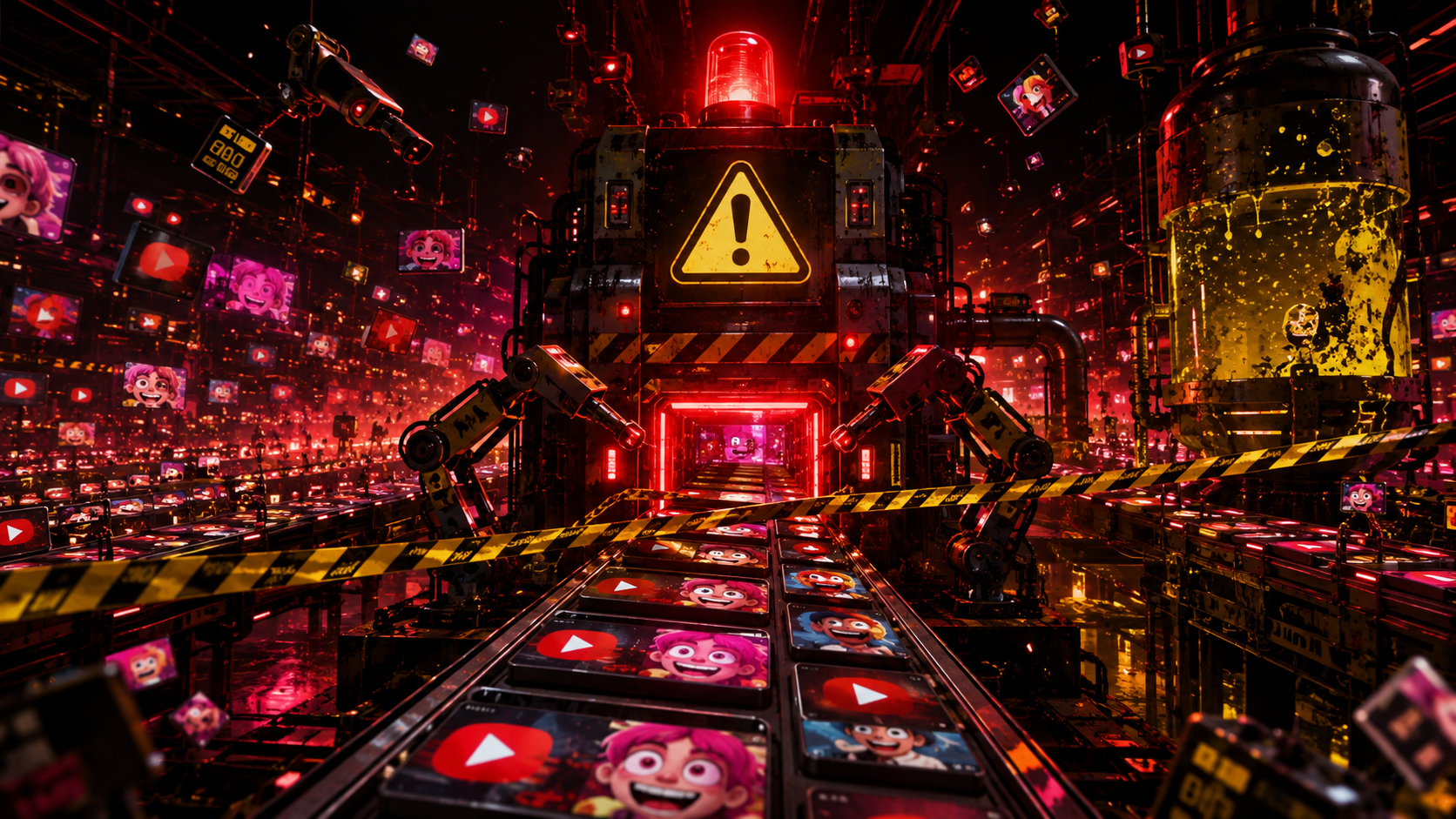
The scale is beginning to look less metaphorical. In June 2026, video-editing company Kapwing published an analysis of TikTok content and said 59% of videos served to a new account’s For You page were AI slop. In the 2,000 videos it sampled from TikTok’s Kids category, it classified 57.4% as slop. Its most extreme result was the #cartoonkids tag, where 97 of the 100 sampled videos were classified as AI-generated slop.
Kapwing is not a child-development lab, and its classification method should not be mistaken for a clinical study. But even as a snapshot, the number tells you something about the supply problem. The factory is no longer theoretical.
A toddler should not need media literacy
The problem with AI slop aimed at children is not merely that it is ugly, though it often is. It is not merely that it is cheap, though it almost always is. It is that children encounter media before they have the critical distance to describe what media is doing to them.
Adults can sometimes feel the difference between something made to say something and something made to remain on-screen. A child often cannot. To them, it is all just content arriving through the same glowing rectangle: handmade animation, educational songs, toy unboxings, machine-generated nonsense, brand camouflage, emotional manipulation, all flattened into one continuous stream.
And when everything arrives through the same portal, quality begins to lose its outline.
More than 230 child-development, education, counseling and advocacy organizations and experts made essentially this argument in an April 2026 letter organized by Fairplay. They asked YouTube and Google to take stronger measures against AI-generated children’s content, arguing that young kids are especially vulnerable to material that distorts reality, overwhelms learning and captures attention without offering much in return.
The exact developmental consequences will be studied for years. We should be careful with dramatic claims about machines “rewiring” children’s brains when the evidence is still developing. But we do not need a brain scan to notice the economic design.
One side of the screen is a child learning what the world is.
The other side is a system learning what keeps the child there.
AI did not invent the children’s content mill
Children’s culture has always been economically attractive because children are impressionable, repetitive, and easily routed toward products. There were content farms before generative AI. There were bizarre algorithm-chasing nursery videos before text-to-video models could keep a cartoon horse approximately horse-shaped for more than seven seconds.
But there used to be friction in the system.
Making a show cost money. Making toys cost money. Animation took labor. Distribution had gates. You could certainly still fill the air with garbage, but garbage had overhead.
AI lowers the overhead and increases the flood.
So what arrives is not merely children’s entertainment but industrial children’s entertainment: content designed by metrics, optimized by engagement logic, and increasingly manufactured by systems that do not understand imagination, play, or care. It knows only correlation.
Children liked the pink cat with giant eyes? Good. Make six hundred more.
Children watched until the transformation sequence? Great. Begin the next video with the transformation sequence.
Children did not click away when the music got louder and the cuts got faster? Excellent. Remove whatever remains of silence, patience, or narrative.
This is how childhood gets slopified: not in one dramatic moment but by a gradual adjustment of expectations. Stories become noise. Images become bait. Characters become interchangeable vessels for retention. The imagination, which should be a field, becomes a funnel.
Boredom is not a software bug
There is always a temptation to overstate this, to start sounding like every generation that feared the new machine. Television would melt brains. Video games would ruin social life. The internet would kill the book. Some of those fears were exaggerated. Some weren’t.
The useful distinction is not “screen versus no screen” or even “AI versus human.” It is between media that asks something of the child and media that merely asks the child to remain available.
Children deserve weirdness made by people. They deserve weirdness made with AI by people who are actually trying to make something. They deserve stories with intentions behind them. They deserve characters someone loved enough to make properly.
They deserve boredom, even.
Especially boredom.
A mind occasionally left alone is still one of the few environments in which something original might grow.
Not everything bright is nourishment.
Not everything animated is alive.
And not everything playing on a child’s screen belongs there.