A disturbing amount of children’s media now looks as though it was assembled after a focus group asked a machine what a child might tolerate while trapped in the back seat of an SUV.
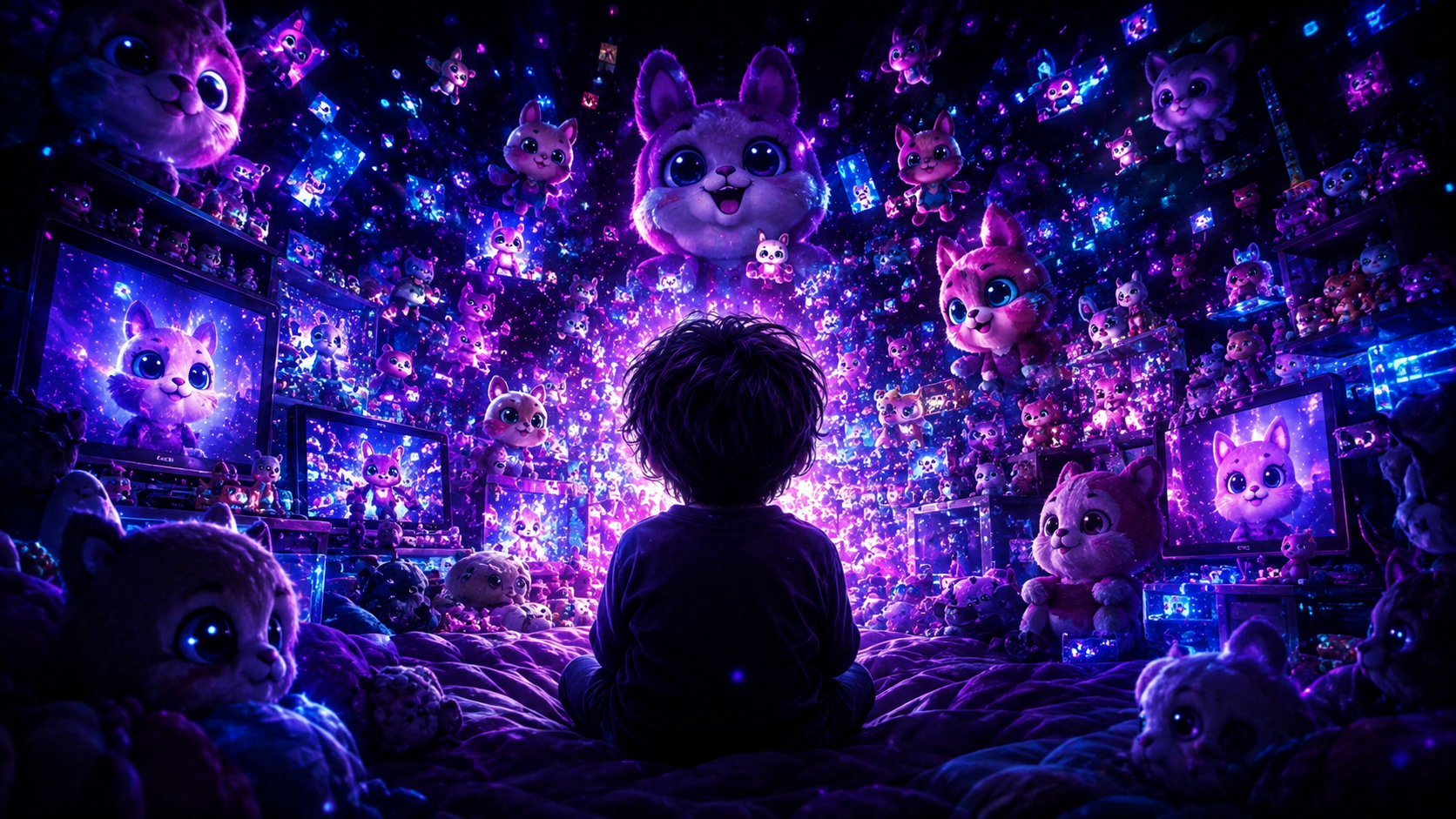
There is a pink animal. Or a blue one. Sometimes there are ten of them. They sing a song that sounds half nursery rhyme, half emergency alarm. Their faces are enormous and emotionally overclocked. Their world is clean in the way a dentist’s waiting room is clean. Nothing in it appears to have weight. Nobody appears to have interiority.
The characters do not act so much as twitch through an endless chain of events optimized for surprise, repetition, and autoplay.
Your child watches, enraptured.
And you, standing in the doorway with a coffee going cold in your hand, have the sinking sensation that the machine has learned how to whistle for toddlers.
Repetition is not the problem
Children’s culture has always involved repetition. Kids want the same story, the same song, the same sequence of events, over and over, until the adults in the room begin negotiating with God.
That is not new. Repetition is part of how children learn.
The issue is what repetition becomes when it is industrialized.
The old repetition of childhood had form. The same bedtime book develops rhythm. The same cartoon episode builds familiarity. The same song becomes a ritual. Repetition could be comforting because it came from something coherent.
AI slop gives you repetition without coherence.
It gives you a loop stripped of almost everything but the loop.
That is why so much of this stuff feels less like entertainment than like a behavioral hack. The “story” is incidental. What matters is the next stimulus. A transformation. A reveal. A shriek of delight. A visual collision. A toy becomes a baby becomes a cat becomes a bus becomes a cake becomes a police officer.
Every few seconds the content effectively asks the child’s nervous system: still there? still there? still there?
Attention is not proof of value
One of the more insulting habits of contemporary tech culture is pretending that if something works on the nervous system, it must therefore be valuable.
The child kept watching, so it must be engaging. The clip held attention, so it must be effective. The character spread, so it must be culturally relevant.
But children will also stare at a spinning siren. Attention alone does not confer worth. Sometimes it merely reveals vulnerability.
This is part of what alarmed the coalition behind Fairplay’s April 2026 letter to YouTube. The group did not merely object to AI because a machine had touched the pixels. It objected to the combination of young audiences, synthetic content, recommendation systems and weak controls. Its requested remedies included clearer AI labels, a ban on AI-generated video within YouTube Kids, and a parental setting that could shut AI content off entirely.
Whether every one of those proposals is workable is a separate argument. The interesting part is what the proposals admit: a label meant for an adult does not automatically become meaningful simply because a five-year-old can technically see it.
A creator is more than a production cost
Children are increasingly encountering culture as abundance without obvious authorship.
This matters because authorship is not a luxury detail. It is one of the invisible structures that give a work texture and moral shape.
A story made by a person is not automatically good. Humans have produced mountains of terrible children’s media with extraordinary dedication. But even bad human-made entertainment usually emerged from a point of view. Someone made choices. Someone cared enough to decide this line instead of that one, this gesture instead of that one, this silence, this pace, this particular kind of weirdness.
Even thoughtful AI-assisted work can have that. MIT Technology Review’s reporting on generative-video creators found people spending hours or days iterating on clips, developing recurring ideas and deliberately using the technology’s unreality as part of the work. Whatever one thinks about the tools, there is clearly a difference between that and pressing a template until enough uploadable minutes fall out.
Slop does not have to be made by AI. And AI work does not have to be slop. The missing ingredient is usually intention.
The slop factory has data on the child. That is not the same thing as having a thought about childhood.
First encounters matter
If this all sounds melodramatic, consider how much of childhood is made of first encounters.
First stories. First visual vocabularies. First emotional scripts. First ideas of what fun feels like, what learning feels like, what imagination feels like.
Those encounters help build taste. They help build patience. They help build the ability to sit with a narrative rather than merely be bounced between stimuli like a pinball in a toy store.
So no, the point is not to ban weird children’s media. Children need weirdness. They need nonsense. They need absurdity. They need things adults find unbearable. This is an ancient and probably healthy arrangement.
The point is to distinguish between weirdness that opens the imagination and weirdness that exists solely to keep the next thumbnail warm.
A child’s favorite cartoon does not have to be a moral masterpiece.
But it should at least feel as though it came from somewhere.
From a mind.
From a joke.
From a voice.
From a room where somebody, however imperfectly, was trying.
Not from nobody.